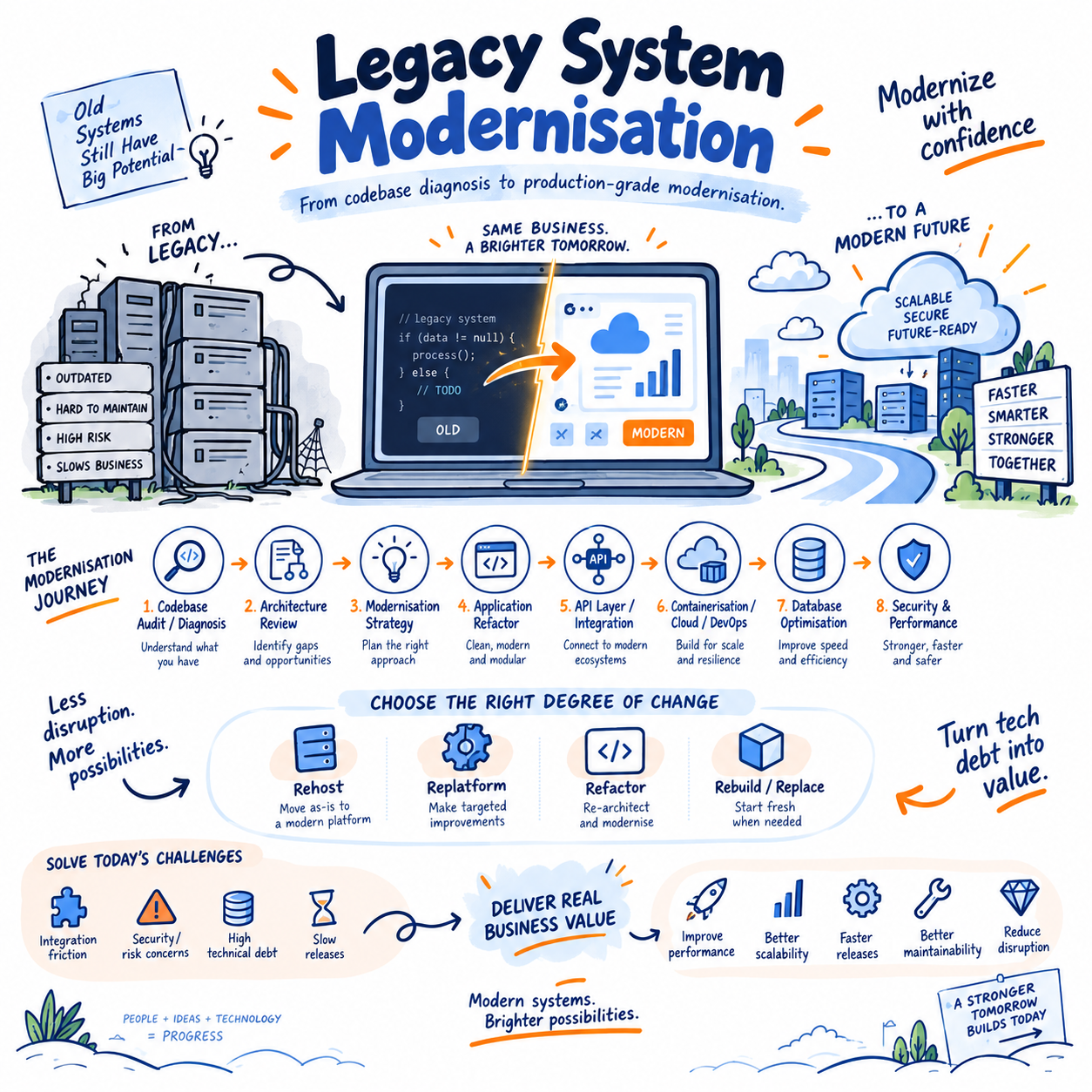

Codebase Audit
Review structure, dependencies, maintainability, duplication, hotspots, and risks to establish a practical modernisation baseline.
Transform ageing applications into secure, maintainable, cloud-ready systems without discarding the business knowledge that keeps your operations moving.
Choose a focused intervention or combine services into a phased programme that reduces technical risk while protecting business continuity.
Review structure, dependencies, maintainability, duplication, hotspots, and risks to establish a practical modernisation baseline.

Map current architecture, integration boundaries, infrastructure dependencies, bottlenecks, and technical constraints.

Prioritise rehost, replatform, refactor, rebuild, or retire decisions around business value, risk, cost, and sequencing.

Transform ageing applications into maintainable, scalable products while preserving critical business behaviour.

Improve code structure and modularity incrementally without forcing unnecessary functional change.

Move away from unsupported libraries, runtimes, and frameworks to reduce security and operational exposure.
Decouple high-risk components, improve maintainability, and prepare systems for further platform or architecture change.
Upgrade technology foundations methodically with regression controls and compatibility testing.

Create automated unit, integration, regression, and critical-path tests that make change safer and faster.

Refresh user experience, accessibility, responsiveness, and front-end architecture without losing proven workflows.

Break monolithic code into clearer modules and bounded components that can evolve independently.

Extract suitable capabilities into independently deployable services where the business case supports the added complexity.

Create secure, versioned APIs that unlock integrations, channels, automation, and gradual replacement of legacy interfaces.

Standardise runtime environments and deployment packaging using container-based delivery patterns.

Improve schema design, access patterns, migration safety, compatibility, performance, and data-service boundaries.

Introduce repeatable CI/CD, environment automation, observability, release controls, and operational feedback loops.
Move workloads with minimal application change when infrastructure is the immediate constraint.
Adopt managed platforms, updated runtimes, databases, or deployment models while preserving core behaviour.
Improve code and architecture to increase maintainability, performance, security, and delivery speed.
Re-engineer capabilities when legacy constraints are too costly to carry into the future state.
We balance engineering ambition with the realities of live operations, regulatory constraints, business continuity, and constrained delivery windows.
| Technology trigger | Business trigger |
|---|---|
| End-of-life frameworks, libraries, operating systems, or databases. | Rising cost and risk of keeping critical systems supported. |
| Monolithic architecture and tightly coupled dependencies. | Slow time-to-market and difficulty launching new products or channels. |
| Low automated test coverage and fragile release processes. | High change risk, production incidents, and missed delivery commitments. |
| Limited API capability and difficult integrations. | Partners, customers, and internal teams need connected digital experiences. |
| Performance, scalability, or resilience limitations. | Growth, geographic expansion, or peak demand exceeds legacy capacity. |
| Security debt and inconsistent operational controls. | Stronger compliance expectations, audit findings, or customer assurance requirements. |
| Technology benefit | Business benefit |
|---|---|
| Cleaner architecture and maintainable code. | Lower change cost and faster feature delivery. |
| Automated testing and CI/CD. | More frequent releases with lower operational risk. |
| Cloud-ready infrastructure and containers. | Improved elasticity, deployment consistency, and infrastructure efficiency. |
| Modern APIs and integration boundaries. | Faster partner integration, automation, and omnichannel capability. |
| Improved monitoring and observability. | Faster incident diagnosis and more predictable service performance. |
Core frameworks, runtime versions, libraries, or databases no longer receive reliable vendor support.
Small product changes require long testing windows, specialist intervention, or extended downtime.
The system struggles with growth, geographic expansion, peak loads, or new customer channels.
The stack relies on niche or ageing technologies that make hiring and knowledge continuity difficult.
Adding APIs, partners, automation, or new channels is risky and disproportionately expensive.
Infrastructure, support, incident, and maintenance costs increase without equivalent business value.
Usually not. We first assess business value and technical risk, then select the least disruptive approach for each part of the system—rehost, replatform, refactor, rebuild, or retire.
Yes. Phased migration, strangler patterns, parallel operation, automated testing, and controlled cutovers can reduce the need for a disruptive big-bang replacement.
We establish baselines, add regression coverage, plan rollback options, modernise in increments, and monitor production behaviour throughout the transition.
Yes. UI, API, data, runtime, DevOps, and infrastructure changes can be sequenced independently when architecture boundaries allow.
The decision should consider regulatory constraints, workload characteristics, latency, existing investments, operating skills, resilience requirements, and total cost—not cloud preference alone.
We can provide hypercare, performance monitoring, backlog support, optimisation, knowledge transfer, and ongoing engineering capacity.